Datasheets, measured data, papers and case studies — everything behind the numbers on this site.
Measured data
The four numbers we publish first
Each one is in a published, dated source. The stamp names it.
256 µs
Best measured qubit T1
MeasuredQiB0 · datasheet v2.010 Oct 2025
90–130 µs
Average T1, QiB0
MeasuredQiB0 · datasheet v2.010 Oct 2025
140 µs
Average T1, QiB2 (up to)
MeasuredQiB2 · datasheet v2.2
±10%
JJ resistance variation within a block
Published specQ-MPW Technical Guide v1.0Feb 2026
Qubit-in-a-Box reference devices
The measured device in each current datasheet, element by element. One shared T1 axis, so the three charts compare at a glance. Datasheets show a measured reference device. Individual characterisation on request.
QiB0CS_QIB0_30
MeasuredQiB0 datasheet v2.010 Oct 2025
Q13.34 GHz138 µs
Q23.49 GHz121 µs
Q33.54 GHz132 µs
Q43.41 GHz109 µs
T1050100150200250300µs
Average T1 per qubit, CS_QIB0_30. Shared 0–300 µs axis, the same on every Qubit-in-a-Box chart.
QiB1QiB1-010
MeasuredQiB1 datasheet v1.126 May 2026
Q13.30 GHz77 µs
Q24.17 GHz56 µs
Q34.22 GHz72 µs
Q43.72 GHz151 µs
Q54.51 GHz101 µs
Q63.47 GHz116 µs
T1050100150200250300µs
T1 per qubit, QiB1-010. Shared 0–300 µs axis, the same on every Qubit-in-a-Box chart.
QiB2QiB2-015
MeasuredQiB2 datasheet v2.2
Q13.85 GHz84 µs
Q24.65 GHz39 µs
C1-25.58 GHz25 µs
Q34.63 GHz20 µs
Q45.13 GHz22 µs
Q53.93 GHz55 µs
Q64.12 GHz47 µs
Q73.19 GHz82 µs
T1050100150200250300µs
Average T1 per qubit and coupler, QiB2-015. Shared 0–300 µs axis, the same on every Qubit-in-a-Box chart. Outlined bar: coupler.
Q-MPW process statistics
The published spec: ±20% junction-resistance variation across the wafer, ±10% within a block, from the Q-MPW Technical Guide. Per-round statistics will be published here, round by round.
⚑The three charts below use illustrative data. They show the format the per-round ledger will take. They are not measurements. Only the ±10% and ±20% bands are real.
T1 across characterised Qubit-in-a-Box qubits
IllustrativeNot measured
median 112 µs
050100150200250300 µs
Illustrative data, not a measurement. T1, average per qubit: 84 qubits on 18 devices, January 2024 – September 2026.
Junction resistance spread within one block
IllustrativeNot measured
−10%+10%
median 8.13 kΩ
6.47.28.08.89.6 kΩ
Illustrative data, not a measurement: 36 junctions, target 8.0 kΩ, 34 inside the band. The hatched ±10% band and the ±20% axis are the published spec.
Junction yield, one Q-MPW wafer
IllustrativeNot measured
Junction yield
93.9%
Junctions in spec
214 / 228
Chip slots passing
32 / 36
Criterion
Room-temperature resistance within ±10% of target
Illustrative data, not a measurement. A chip slot passes when all its junctions are in spec.
ABCDEF
Pass · 32
Fail · 4
Datasheets & guides
The current version of every document. Superseded versions are not linked.
Datasheets show a measured reference device. Individual characterisation on request.
Volodymyr Monarkha, Massimo Borrelli, Reza Hajitashakkori Kenari, Mohammad Kobba, Eugenio Cataldo, Beer de Zoeten, Mahnaz Zarrinfar, Kamal Pandey, Abhinand Pusuluri, Filippo D. Michelacci, Eliot Jouan, Bennett Sprague, Simon Gröblacher, Thierry C. van Thiel, Robert Stockill, Russell E. Lake
arXiv · 2603.18780
n.d.
Optimising qubit performance in the L-Type Rapid cryostat (application note, with QiB0)
Kiutra
Kiutra application note
Our publications
Three peer-reviewed papers by our engineers on loss mechanisms in aluminium-on-silicon qubits and resonators (npj Quantum Information, Physical Review Applied, APL Quantum, 2024).
Janka Biznárová, Amr Osman, Emil Rehnman, Lert Chayanun, Christian Križan, Per Malmberg, Marcus Rommel, Christopher Warren, Per Delsing, August Yurgens, Jonas Bylander, Anita Fadavi Roudsari
Lert Chayanun, Janka Biznárová, Lunjie Zeng, Per Malmberg, Andreas Nylander, Amr Osman, Marcus Rommel, Pui Lam Tam, Eva Olsson, Per Delsing, August Yurgens, Jonas Bylander, Anita Fadavi Roudsari
APL Quantum · 1 · 026115
Papers using our devices
33 papers by research groups that used our devices, 2012–2025.
Filter by area. Titles link to the paper where a DOI is on record.
2025
Phenotypic drug susceptibility testing for Mycobacterium tuberculosis variant bovis BCG in 12 hours
Buu Minh Tran et al.
Nature Communications · 16 · 4366 · Life science
2025
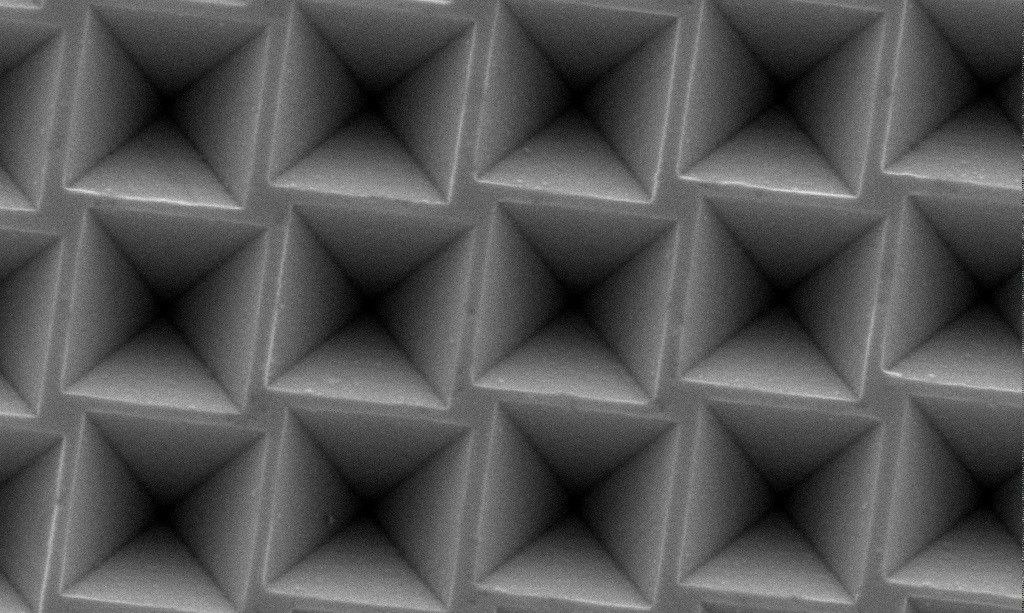
Strong chiro-optical activity of plasmonic metasurfaces with inverted pyramid arrays
L. A. Pérez, J. Hu, J. Mendoza-Carreño, M. Garriga, M. Isabel Alonso, O. Arteaga, A. R. Goñi, A. Mihi
Transcription-factor binding and sliding on DNA studied using micro- and macroscopic models
Marklund, E. et al.
Proceedings of the National Academy of Sciences · 110 · 19796–19801 · Life science
2013
Photon upconversion facilitated molecular solar energy storage
Börjesson, K. et al.
Journal of Materials Chemistry A · 1 · 8521 · Energy
2012
Lipid-based passivation in nanofluidics
Persson, F. et al.
Nano Letters · 12 · 2260–2265 · Life science
Case studies
Quantum · teaching
Niels Bohr Institute
Runs QiB2 in its Quantum Training Lab.
We have been using the QiB2 device in the Quantum Training Lab at the Niels Bohr Institute since 2024. The device is well suited for this purpose since it allows for the evaluation of different properties of superconducting qubits.
Kim SplittorffAssociate Professor, Niels Bohr InstitutePlug'N'Teach→
PhotoQuantum Training Lab · QiB2 mounted on the mixing-chamber plate
Plasmonic sensing · scale-up
Insplorion
Scaled up nanoplasmonic sensor fabrication with faster throughput and standardised QC.
The mix of fast and flexible in combination with highly competent and knowledgeable service from ConScience has been essential in the development of our technology and our company.
Reproducible nanostructure masters for soft nanoimprint lithography.
The ability to quickly access high-quality nanostructures from ConScience has been essential to our research. Their support enables us to explore advanced photonic architectures with confidence.
Agustin MihiNanophotonics Group, ICMAB-CSIC
Papers
Chiral plasmonic superlattices from template-assisted assembly of achiral nanoparticles
Qi, X., Pérez, L. A., Mendoza-Carreño, J. et al. · Nature Communications 16 1687 · 2025
Strong chiro-optical activity of plasmonic metasurfaces with inverted pyramid arrays
L. A. Pérez, J. Hu, J. Mendoza-Carreño, M. Garriga, M. Isabel Alonso, O. Arteaga, A. R. Goñi, A. Mihi · ACS Applied Materials & Interfaces 17 (10) 15824–15835 · 2025
SEM · ICMAB-CSIC
Cell biology · VerCINI
Newcastle University
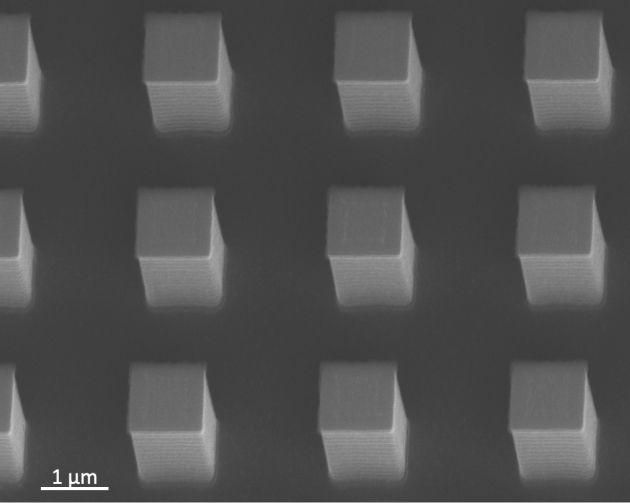
Nanopillar wafers for the VerCINI vertical-imaging method, made available to other labs.
Paper
FtsZ treadmilling is essential for Z-ring condensation and septal constriction initiation in Bacillus subtilis cell division
Whitley, K. D., Jukes, C., Tregidgo, N. et al. · Nature Communications 12 2448 · 2021
SEM · Newcastle University
Microfluidics · mother machine
UC San Diego
Custom mother-machine molds; repeat customer.
We endorse them. We designed & ordered multiplex mothermachine from them about a year ago. They delivered an excellent product. The price was reasonable, certainly far less than what it cost us back in 2008 at Harvard for the first mothermachine. We will use them again.
Suckjoon JunInventor of the mother machine, UC San DiegoMicrofluidics→